Category: Prevention

  • Being Prepared for Parkinson’s Disease

    Being Prepared for Parkinson’s Disease

    April is Parkinson’s Awareness Month, and the theme for 2022 is preparing for the future. When you or a loved one are diagnosed with Parkinson’s Disease, preparing for the future includes planning for and managing care related to this progressive disease. Here is some important information regarding Parkinson’s.

    What is Parkinson’s?

    Parkinson’s is a degenerative neurological disorder that affects movement. Symptoms of Parkinson’s include increasing tremors, particularly of the hands, rigid limbs, balance and gait problems, and slow movement or freezing known as Bradykinesia. Treatment options include medications and surgery.

    How Does Parkinson’s Affect Quality of Life?

    Parkinson’s is a progressive disease, which means that the symptoms manifest and change over time. Because of the interference with motor skills that occurs with Parkinson’s, people with the disease experience reduced capacity for activities of daily living. This can include operating machinery such as a car, and even simple activities like taking a walk can be difficult for someone with Parkinson’s symptoms. Other activities, like managing finances, can be impaired because there is a physical element to things like paying bills or simply making a phone call to a financial advisor. As the disease progresses, basic mobility, bathing, dressing, and feeding oneself become impossible without assistance.

    Planning for Parkinson’s

    Generally, a Parkinson’s diagnosis occurs after some symptoms have begun to show, but before the disease has progressed very far. This creates an opportunity to plan for the eventual degeneration of physical abilities that occurs in all people with Parkinson’s. Before reaching the critical phase, a person with Parkinson’s, or their loved ones, should consider where they want to receive care. If they want to remain at home, they will need to plan. This can include some basic or major remodeling that is best done before the need arises. Planning should also include identifying the care that is and will be needed with everything from getting to doctor’s appointments, basic housework, and physical care.

    Based in Gaithersburg, CarePlus Home Health is a Montgomery County home healthcare provider, working with clients in Maryland and Washington, DC. We have a team of experienced caregivers who work with people with Parkinson’s, and we understand the challenge of meeting the change in a person’s abilities as it progresses. We begin our work with a client with a thorough in-home assessment, and we revisit our client’s needs regularly to make sure that they are receiving the care they need. For more information about our special services for people with Parkinson’s, contact us today.
  • May is National Stroke Awareness Month

    May is National Stroke Awareness Month

    According to the National Institutes of Health, “Each year in the United States, there are more than 800,000 strokes.”

    Strokes are the fifth leading cause of death in the United States, according the Centers for Disease Control. More than any other disease a stroke can cause serious, long-term disabilities. The American Heart Association Stroke Council (ASC) says that stroke victims are vulnerable to repeat strokes.

    CarePlus Home Health would like to offer you a few tips on how to recognize stoke-like symptoms and the necessary steps to take to reduce the risk of having a stroke.

    What is a Stroke?

    When a major blood vessel in the brain is either blocked by a clot or bursts, a portion of the brain cannot get the blood it needs, causing brain cells to die.

    This is a stroke.

    What Causes a Stroke?  

    The two-most common types of strokes are hemorrhagic and ischemic.

    • A hemorrhagic stroke occurs when a weakened blood vessel in the brain ruptures. High blood pressure is the most common cause of a hemorrhagic stroke.
    • An Ischemic stroke occurs when a blood vessel supplying blood to the brain is obstructed. According to the ASC, ischemic strokes account for 87% of all strokes.

    When a person has a stroke, depending on where in the brain the stroke occurs, the part of the body controlled by that part of the brain cannot function. Short of death, strokes can cause paralysis, loss of vision, memory loss as well as other possible outcomes – some of which are irreversible.

    Remember to ACT FAST!

    Medical intervention is needed as quickly as possible when experiencing stroke symptoms.

    According to the Mayo Clinic, an ischemic stroke requires specific pharmaceuticals to break up the clot in the brain; medication should be administered “within 4.5 hours from when symptoms first started if given intravenously.

    The sooner a stroke patient is treated with medication, the better. Quick medical treatment may not only improve a stroke victim’s chances of survival, additional medical complications may be avoided.

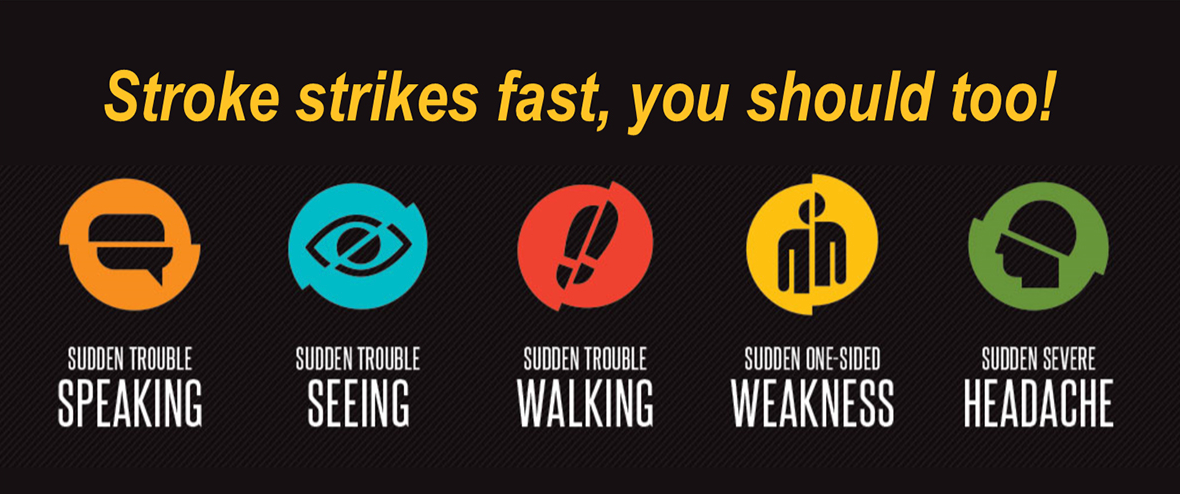
    According to the Centers for Disease Control, the acronym F-A-S-T can help you remember stroke symptoms. 

    F = Face drooping: Ask the person to smile. Does one side droop?

    A = Arm weakness: Ask the person to raise both arms. Does one arm drift downward?

    S = Speech difficulty: Ask the person to repeat a simple sentence. Are their words slurred?

    T = Time to call 9-1-1: If the person shows any of these signs, call 9-1-1 immediately. Stroke treatment can begin in the ambulance.

    Additional stroke symptoms include dizziness; loss of balance or coordination; trouble walking; problems seeing out of one or both eyes; severe headache; numbness of the face; and sudden confusion or trouble understanding others.

    Keeping in mind the FAST signs (see above), it is imperative to contact emergency services as soon as possible if you or someone else displays any stroke symptoms.

    Do NOT Let COVID-19 Prevent You From Seeking Treatment

    Millions of Americans are rightfully following the CDC’s social distancing guidelines with respect to COVID-19; however, these social distancing measures should not prevent you from getting emergency medical attention should you experience stroke-like symptoms.  

    Call 911!

    Emergency medical technicians (EMTs) are trained to assess your condition and take immediate steps to hospitalize someone having a stroke. The risks associated with not obtaining treatment for a stroke far outweigh the potential exposure to COVID-19, particularly when healthcare professionals involved – from the EMT to the treating doctors and nurses – are made aware of any underlying health concerns (e.g., a compromised immune system).

    Take Care of Yourself!

    The CDC offers the following stroke prevention guidelines:

    • Eat a healthy, low-sodium diet; include plenty of fruits and vegetables;
    • Maintain a healthy weight;
    • Be physically active.
    • Do not smoke;
    • Avoid secondhand smoke;
    • Limit your alcohol use;
    • Prevent or manage your other health conditions, especially high blood pressure, high cholesterol, diabetes, and obesity.

    Some contributing strokes factors – age, race and gender, for example – are outside of your control. Living a healthy lifestyle, however, can help prevent you or your loved one from having a stroke.


  • 15 Ways to Help Someone With Dementia Avoid Falling

    With fall here, it is an appropriate time to talk about the real danger that falls can present to many of our patients and loved ones. As we age, 15 Ways to Help Someone With Dementia Avoid Falling graphicwe begin to develop problems with depth perception and judgment, and our brain and body begin to have trouble coordinating signals. Our highly trained home caregivers are well versed in the danger falls can present, as well as catching warning signs and creating preventative measures. Here is a great article with just a few of those tricks for avoiding falls.
    “You can’t completely prevent falls — accidents do happen. Adults over age 65, and older adults with dementia in particular, are at a higher risk of falling, for some well-known reasons. These include a higher use of prescription drugs, more night waking, shuffling and other coordination problems, and weakening musculature and balance.

    Most falls in people with dementia are “multifactorial,” meaning that a combination of problems contributed to the fall. This makes it especially hard to eliminate falls altogether. But it’s almost always possible to identify risk factors that can be changed or risks that can be compensated for.

    What you can do…” Continue Reading >>

    If you are worried about falls and are located in Maryland call (301) 740-8870. We provide home care and home nursing services and offer free in-home evaluation!

  • Top 10 Hidden Sources of Salt

    Did you know heart disease is the leading cause of death for both men and women? We understand how important your loved ones healthSalt image concerns are and we hope these tips will help.
    “After a diagnosis of heart failure, “reduce salt intake” is one of the first pieces of advice doctors offer. Sodium contributes to fluid retention, and too much sodium is one of the most common triggers for exacerbation. For this reason, doctors recommend that those with heart failure limit salt intake to 1,500 to 2,000 milligrams of sodium per day.

    But how to do that? Start by following recommendations for managing diet for heart failure. Putting away the salt shaker helps, as does learning to cook with other flavors, such as garlic, citrus, and herbs. However, many people find it’s much harder than they expected to reduce sodium intake,” Continue reading>>

  • 7 Questions to Ask the Doctor About Preventing Falls

    Falling is more common among the elderly and we understand the impact it can be for the elderly and the family. We hope these tips will 7 Questions to Ask the Doctor About Preventing Falls graphichelp you and your loved ones in preventing falls.
    “Each year one in three adults age 65 years or older falls, according to the Centers for Disease Control and Prevention, and the possibility of serious injury from falling increases even more dramatically by the time your parents reach the age of 85.

     When accompanying your parents on a doctor visit, use the opportunity to find out if your parent is at risk for falling and what can be done to prevent a fall. The questions below should help. (Make sure to bring along all your parent’s prescriptions and over-the-counter medications.)”  Continue reading>>

  • Help Seniors Beat the Dangers of Summer Heat

    Sweltering humidity and temperatures over 90 degrees are dominating our Maryland in home care service areas (Gaithersburg, Help Seniors Beat the Dangers of Summer Heat graphicGermantown, Rockville, Potomac, Silver Spring, Bethesda and beyond) this week. As such, we thought it would be helpful to post some heat beating tips for seniors. If you need in home care, part time assistance or simply some advice call CarePlus Home Health in Gaithersburg, Maryland at (301) 740-8870. We have over 18 years of experience and we are here to help!

    Help Seniors Beat the Dangers of Summer Heat

    “Summer’s here. And with it come health risks for seniors. Older people are especially vulnerable to heat illnesses, as elaborated on by the Centers for Disease Control. The two biggest risks are heat stroke (extremely serious) and heat exhaustion (milder than heat stroke but still serious). Dehydration and heat cramps are in there, too.

    There are several things you can do to help protect your parents from the dangers of baking-high temps.

    Make sure they:

    • Are drinking plenty of hydrating fluids, like water, and avoiding dehydrating fluids, like alcohol and caffeinated beverages
    • Limit time in the direct sun and wear hats, sunglasses, and sunscreen…” Continue Reading >>
  • Cancer Survivors: 8 Lessons We Wish We’d Known

    In honor of National Cancer Survivors Day coming up on the first Sunday in June, we are sharing this fantastic insight straight from cancerNational Cancer Survivor's Day logosurvivors themselves. Our home caregivers are honored to get to be an integral part of cancer care teams throughout our Maryland home care service areas, and we love to share any little bits of insight that might make this trying time a little bit better.

    “A few years back, New York Times reporter Dana Jennings posted a very moving blog titled Ten Lessons of Prostate Cancer.

    It touched a nerve for me — and many of us in Cancer World — because we all have a desperate desire to connect with others living with cancer in their lives and discover the tidbits of knowledge that only experience can teach. At Caring.com, we have a series of articles titled What I Wish I’d Known, in which well-known people share the lessons they learned in caring for loved ones. Below, in my own personal order of importance, are a few of Dana Jennings’ ten lessons, augmented with others from the more than 260 people who commented on his blog, and still more from community members at Caring.com who’ve taken the time to share their wisdom in group postings and answers to others’ questions.” Continue Reading >>

  • 10 Healthy Holiday Substitutions

    With Thanksgiving on its way, the holiday season of 2011-2012 is just about ready to kick off–and with that comes lots of delicious (and usually not terribly healthy) holiday food!

    It may not be easy, but it’s a good idea to try not to overindulge during the holiday season–and there’s no shortage of tips on how you can succeed at that. One of the best ways? Make substitutions while cooking! We’ve listed some of our favorite substitutions, many of which we’d never even thought of before.

    1. Applesauce for oil or butter. Switching out the fatty oils for applesauce isn’t a new idea, but it’s one a lot of people might not be willing to try. The texture’s just right, though, and thanks to the natural sugars in fruit, even unsweetened applesauce can lend some sweetness to your baking!
    2. Graham crackers for cookies in pie crusts! Pies are one of the holiday standards, and while everyone loves a good Oreo or cookie crust, swapping that out for reduced-fat graham crackers can cut out up to half the calories while still tasting great!
    3. Stevia for sugar. This natural sweetener, which has recently been gaining in popularity is now more readily available, is lower in calories than sugar and up to 300 times sweeter. You read that right–300 times. Popular brand names are Sweetleaf and Truvia.
    4. Prosciutto for bacon. While bacon is an American standard year-round, it’s also well-known to be a major (if majorly delicious) health hazard. Prosciutto can lend a similar taste while having half the calories and two-thirds as much fat!
    5. Nuts for croutons. Serving up salad as a healthy option with your holiday meals? Croutons add a desirable crunch, but they can also pack quite a lot of fat and sodium. Instead, try lightly toasted almonds, pecans, or walnuts! Not only will you be eliminating those extra carbs, but nuts sneak in some extra omega-3 fatty oils.
    6. Pureed fruit for syrup. Looking to warm up on cold mornings with some waffles or pancakes? Instead of slathering them with syrup, try pureeing fruit with a bit of honey; it packs in a lot less sugar, and when it’s warmed on the stove beforehand, tastes even better.
    7. Frozen bananas for ice cream. You read that right! Freeze a couple of bananas overnight, then puree them in the blender; drizzle in a little bit of honey and some cinnamon. The texture’s almost identical, and the taste is to die for!
    8. Ground turkey for ground beef. Since turkey is a leaner meat, it makes a great (and seasonal!) substitution for ground beef. A few spoonfuls of chicken stock can keep it from drying out!
    9. Dry beans for canned beans. Sure, canned beans may be more convenient, but they’re so high in sodium and preservatives! Stock up on some dry beans; all it takes is a little extra soaking and boiling.
    10. Marshmallow Fluff for the butter and sugar in frosting. Believe it or not, this childhood favorite is actually healthier than most frosting; 2 tablespoons is not only fat-free, it only has 40 calories and 6 grams of sugar, while conventional frosting can pack in up to 100 calories and 14 grams of sugar (not to mention all that fat)!

    Of course, indulging in some of the ‘bad’ stuff around the holidays isn’t a mortal sin–feel free to treat yourself, but remember that, like with all things, moderation is key!

    Do you have any favorite substitutions? Let us know!

  • Basic Storm Preparedness – For Any Season!

    These tips and tricks can help you stay prepared for bad weather in any season.
    • Stock up on bottled water. If the power goes out or the water supply is affected by the storm, you’ll need it!
    • Dig out your battery-powered radio and some flashlights. Even if we lose power, you’ll want to stay aware of what’s going on – and don’t forget to stock up on batteries to run them!
    • Charge your cell phones in advance. Also, if it becomes difficult or impossible to make phone calls in the wake of a disaster, try sending a text instead–they use less data than actual calls, and are more likely to get through.
    • Make sure you have plenty of non-perishable foods, especially things that don’t require refrigeration or heating. Keep your refrigerator closed as much as possible if the power goes out–conserve food!
    • Gas up your car. A full tank of gas is always a good thing to have, especially in emergency situations.
    • Keep a first-aid kit at hand. We all hope you won’t have to use them – but if worse comes to worst, make sure you have the supplies you need ready!
    • DON’T leave shelter during severe weather unless it’s absolutely unavoidable.
    • DON’T drive into standing water – flash floods are dangerous!
    • If you’re caught outside during severe weather, DON’T take shelter under a tree.
    • Move to a central part of your house in the event of a weather emergency such as a tornado or strong winds; stay away from windows and secure them as much as possible.
    • Check up on your neighbors, especially if they’re elderly, have young children, or are ill.
  • A Joke a Day Keeps the Doctor Away

    We’ve all heard about it before, the power that positive thinking has on our physical health. To many, it sounds hokey, especially given today’s chaotic mix of proven, cutting-edge scientific techniques and the resurgence of holistic and alternative medicine. Is there any truth to it? And if there is, how exactly does a good attitude affect your physical health?

    In a recent survey of over 160 studies on the subject, lead by University of Illinois professor emeritus of psychology Ed Diener, there was a surprisingly consistent result: that a positive attitude did, in fact, give you better chances of having good health and more longevity.

    Not only did otherwise healthy people live longer and healthier lives when they felt more positively about their lives, but animal studies backed that up. Animals who received the same treatment (food, exercise, attention, etcetera) but were exposed to more stress (by having less space or more cage mates) had weaker immune systems and a higher incidence of heart problems—and, not incidentally, higher mortality rates.

    But why is this the case? Experiments have proven that stress-related hormones are reduced and immune function is increased when humans experience positive emotions; they even promote the recovery of the heart after exertion!

    Even scientists, though, seem to be surprised by the apparent conclusiveness of this evidence. Diener is quoted as saying that he is “certainly surprised to see the consistency of the data.” He also cautions that “happiness is no magic bullet” and that some studies show exceptions to this rule, but does suggest that doctors should be urging their patients to not only eat right, exercise more, and avoid smoking, but to try to increase the positivity with which they view their daily lives.

    Easier Said Than Done

    Changing your lifestyle is hard enough, when you get right down to it—but changing the way you think can seem like a nearly impossible task. We get so trapped by our thought patterns that it can seem like a Sisyphean task to break through or change them. Is it even possible to change the way you think?

    It is—but it’s not easy. The sheer amount of money spent in modern society on therapy, self-help books, and other methods of attempts to gain clarity on the human mind and the sources of its conflicts—from psychics to mediators and lawyers—is a testament to that. And you certainly won’t learn how to change your thought processes by reading a blog in a newsletter. There are, however, a few beginning steps you can take.

    1. Try to let go of past grudges. Is it really doing you any good to hold onto that hurt?
    2. Appreciate the good things in life. Try making a list at the end of the day of all the good things that happened to you since you woke up.
    3. Do nice things for other people. You’d be surprised what a boost this can give your own mood!

    It may not be easy to do, but adjusting the way you think about your life may just end up being more than a mental health benefit—you could see it reflected in how long you live, as well.