
Category: Cognitive Function

  • Holiday Wellness Check on Aging Relatives

    Holiday Wellness Check on Aging Relatives

    With the holidays comes a chance for families to gather together in celebration. Sometimes, this is a rare opportunity to see a relative who lives far away. If that person is aging and they live alone or with another aging person, it is an excellent idea to check out how they are doing. Phone calls, and even video calls, don’t tell the full story that an in-person visit might reveal about their needs for health, comfort and safety.

    Self-Neglect

    As people age, some ordinary life activities may become increasingly difficult or skipped altogether. The National Institutes of Health (NIH) identifies these signs of self-neglect that can be spotted during a short visit.

    • Hoarding
    • Failure to take essential medications or refusal to seek medical treatment for serious illness
    • Leaving a burning stove unattended
    • Poor hygiene
    • Not wearing suitable clothing for the weather
    • Confusion
    • Inability to attend to housekeeping
    • Dehydration

    If you see these signs, it is time to work with that parent to get some additional care.

    Cognitive Health

    One of the biggest challenges to aging is the failure of cognitive health – the ability to think, process, and remember. Dementia from Alzheimer’s disease or another cause can severely impact the health and safety of a loved one, so it is important to look for signs of impairment. Memory loss, change in mood, taking longer to complete daily tasks, losing items or placing them in odd locations, and repeating questions are among the early symptoms that the NIH warns to look out for. There are many potential causes of these issues, so getting a proper medical assessment is critical for early treatment and intervention.

    Mental Health

    Older people suffer from mental health challenges, including anxiety and depression. As they slow down and become frailer, they may limit their social activities, and isolation can both increase mental health challenges and make them harder to identify. Where a relative may perk up for a phone call, their overall mental health might be in decline and need attention. In person, they might be more willing to open up about their struggle.

    Don’t Do it Alone

    Checking in with your loved one’s health care provider, minister and other sources of support is an excellent way to get a clear picture of the situation that your loved one may be reluctant to reveal. If they aren’t available during your visit, you may want to consider working with a professional to do an assessment. Trained social workers and other professionals with experience working with the elderly can help identify red flags and offer suggestions and solutions that may make life easier for your loved one.

    At CarePlus Home Health, we begin all of our relationships with clients by conducting a thorough in-home evaluation. We do not charge for this service, because we think it’s critical to establish trust and assess the situation to propose the right solution. If your loved one is located in Montgomery County, Howard County or Prince George’s County and you would like to schedule an in-home evaluation while you are in town, contact us today.

  • Living At Home With Alzheimer’s

    Living At Home With Alzheimer’s

    For adults with memory impairment like Alzheimer’s, change can be difficult, so it is no surprise that the prospect of moving out of the home and into a care facility is met with resistance. According to research published in the Journal of American Geriatrics, there has been an increased trend for people with dementia to prefer staying at home for as long as possible. However, staying at home presents some significant challenges, particularly for people who live alone. With some awareness and forethought, it is possible to stay at home. Here are some important considerations.

    Managing Activities of Daily Living

    As dementia progresses, many activities of daily living (ADL) become increasingly difficult. From grocery shopping to cleaning, household chores become confusing, and often they are neglected. In addition, personal care like bathing, dressing, and grooming can be forgotten or avoided. As dementia progresses, individuals require increasing assistance with ADLs, which may be beyond the capacity of family, especially if they don’t live together. It’s important to regularly assess the status of ADL abilities and make adjustments to meet increased needs. 

    Assuring Safety

    Individuals with Alzheimer’s suffer from progressive cognitive decline, which impacts many aspects of their safety. Something as simple as remembering to turn off a stove can be a major hazard for someone with memory and focus impairment. Since Alzheimer’s affects older adults, there can be physical challenges that are exacerbated by dementia, such as an inability to problem solve in the event of a medical emergency like a fall or a kitchen accident. Also, dementia can lead to “wandering” – where a person gets lost in their own neighborhood because they simply can’t remember where they live. With care and planning, each of these and many other safety elements can be addressed, and measures can be taken to adapt to increasing impairment as the disease progresses.

    Avoiding Isolation

    Loneliness and isolation are a problem for all people who live alone, but for people living with Alzheimer’s the consequences can have a real, negative impact on their continued ability to live in their own home. A recent Washington Post article identified a significant increase in individuals with Alzheimer’s who experienced isolation due to the COVID-19 protocols. Since dementia can make even simpler technologies difficult to manage, in-person contact is critical to the continued health and well being of people with Alzheimer’s. 

    In order to take care of these and other issues that impact people with Alzheimer’s living at home, we recommend beginning with a thorough assessment by a specialist in geriatric and memory-care concerns. The assessment should look at all of the factors in the home that might pose a difficulty or even a threat. Once the assessment is complete, there are a number of ways to address the findings. In-home care offered by trained specialists like our team at CarePlus Home Health can be an important part of the solution. Located in Montgomery County, our team is highly trained in the care, dignity and safety of our clients with Alzheimer’s. We offer in-home assessments as well as a wide range of customized services to best address the needs of each individual. Contact us to find out how we can help.

  • Alzheimer’s & Brain Awareness Month

    Alzheimer’s & Brain Awareness Month

    June is National Alzheimer’s & Brain Awareness Month. This month CarePlus Home Health took part in programming that helped us raise awareness and support for Alzheimer’s Disease. 

    Alzheimer’s Disease is a progressive disease that damages memory and other important mental functions. Memory loss and difficulty thinking are common symptoms and contribute to mental decline. Some other symptoms are:

    • Problems with language, visualizing and spatial relationships 

    • Difficulty performing familiar tasks 

    • Disorientation with time and place

    • Poor judgment 

    • Attention issues

    • Changes in mood, behavior or personality  

    • Loss of desire or initiative

    Better Care, Better Health – Alzheimer’s Association National Capital Area Chapter


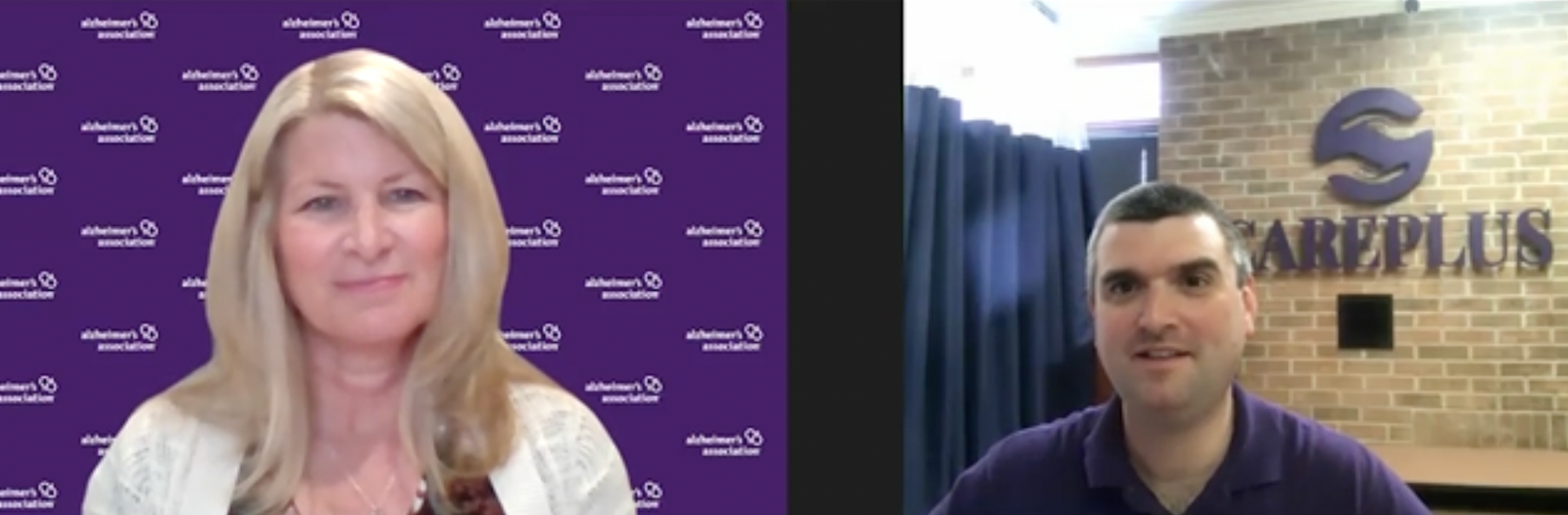
    Our CarePlus Executive Director, Andrew Ryan, sat down with Sheila Griffith, Program Manager for the National Capital Area Chapter of the Alzheimer’s Association. They discussed all of the exciting programs coming up for the Alzheimer’s Association including the Longest Day and the Alzheimer’s Walk!


    The Alzheimer’s Association National Capital Area Chapter offers many different resources to support you and your loved one in all stages of the disease. From support groups to educational programs, there is something to guide everyone through this difficult time. 

    CarePlus is here for you!

    Our services are adjusted to meet your needs. Whether you need us for a few hours a day, or 24/7, we can support you and your loved one. Our caregivers can help with memory care, lifestyle strategies, nutrition and daily living, physical stability, mobility and exercise, and fall prevention. 


    Let’s Get Started. Call us today at (301) 740-8870 or email us at info@careplusinc.com to discuss your needs. We are here 24/7 to help you.

  • Staying Cognitively Active

    Staying Cognitively Active

    Can we help prevent cognitive change?

    We know that as we age, our body and brain change as well.   Every so often we might forget a name, word or birthday. While inconvenient, is it indicative of something else? Some forms of forgetting are expected, while some may signal a more significant change. Can any of these changes be prevented, or, can we slow down the changes? Research does seem to indicate that we can help slow down these changes.

    While there are quite a few risk factors for cognitive change beyond our control, there are activities that we can control that could help slow down these changes.  These activities include: eating healthy, regular exercise and consistent mental and social interactions. These lifestyle habits seem to comprise a promising strategy to prevent cognitive decline. Journal of Geriatric Medicine

    Given the continuing research into the aging brain, and the increase in our older population, we can expect more studies, research and helpful strategies to slow down these changes. So, let’s do our part and start engaging in these strategies.

    Let’s take a look at these three activities that may help a healthy brain.

    Eating Healthy

    In our March blog we discussed healthy eating and shared our tips for successful eating plans. Healthy eating is a good defense against many diseases and ailments–both physical and mental. The research continues to support the benefits of well-planned meals filled with fruits, vegetables, lean meats and fish. A Mediterranean style diet includes whole grains, legumes, fruits, vegetables, olive oil, nuts and fish. This diet continues to deliver health benefits that can: lower cholesterol, help with weight loss, improve rheumatoid arthritis, and reduce the risk for developing Alzheimer’s disease, diabetes, and various types of cancer. Harvard Medical School, Health Blog 2013.

    Regular Exercise

    After checking with your doctor, develop an exercise plan that works for you. Find a good pair of walking shoes and take that walk, attend an aerobic exercise class, enroll in a strength training program, try water aerobics or even ballroom dancing. When you get moving you find yourself feeling better, moving better and, yes, the research suggests thinking better.

    Mental and Social Interactions

    Staying Cognitively Active

    Keeping your brain active includes not only socializing with friends, but learning new skills as well. The National Institute on Aging (May 17, 2017) noted that: “engaging in meaningful activities, like volunteering or hobbies, help you feel happier and healthier.  Learning new skills may improve your thinking ability, too.” Research seems to indicate that adults who learn something new help improve their memory.  And, as it happens, April is National Volunteer month. This is a great month to offer your skills, time and expertise to help others—keep your brain active as well. And, remember there are other ways to exercise your brain: read a good book, teach a class, learn a new hobby, etc.

    So, while the evidence is still coming in, eat well, exercise often and keep your brain strong and ready with new activities and social connections –for your best future!

    And, if you need assistance, we are here to help you by providing fall prevention assistance, skilled nursing and palliative care, as well as caregivers for dementia care and other elder care needs.